Friday, February 29, 2008

Interesting Chemistry

The knowledge on chemistry I gained today was very interesting, but there were still some pieces that were unclear so I decided to investigate the missing pieces. Precipitate reactions are those in which two soluble solutions are mixed together to form a liquid and a solid in which the solid in insoluble. This solid is a salt that is submerged in the liquid and does not dissolve. This salt is also known as the precipitate. Then there are solubility rules for ionic compounds. What could they be? Turns out they are rules that dictate the solubility of ionic compounds in water. There are many rules stating which elements form precipitates and which ones do not. For example, let’s say you mix any Group 1 elements with another element in water. There are rules stating that all Group 1 elements are always soluble therefore you know that the solution is going to be one of no reaction and no precipitate will form. However there are other rules that state that some elements such as chloride will form a precipitate when mixed with elements such as lead. Now on to acids and bases. Acids and bases can be really hazardous to human tissue since they can easily break it down. Acids and bases can be both corrosive. The more concentrated they are the more corrosive they are. Acids are things such as lemon juice, vinegar, and carbonated drinks. Bases can be baking soda, lime, and ammonia. When Acids are dissolved in water they form Hydrogen ions while Bases form Hydroxide ions. When an acid and a base are mixed together they neutralize themselves and form water. Here is a way of being able to recognize an acid or a base just by looking at the chemical formula. If the chemical formula contains an H, for hydrogen, or and OH, for hydroxide, then you should be pondering if this chemical formulae is an acid or a base. Now if it does contain and H or OH look at the next letter, if it is a metal then the chemical formula means the element is a base. If the letter next to it is a nonmetal then it is an acid. Of course there are exceptions to this rule but these rules cover most chemical formulas.

Wednesday, February 27, 2008

The Dust Bowl

During my delving of the era between WWI and WWII I found interesting photos about the infamous Great Depression. We all know that the Great Depression was a time of economic failure and imbalance in wealth distribution. But there were other things happening at the time that made life for Americans even worse. For example, the Dust Bowl hit the Midwest hard and stopped farming production there leaving farmers without a job and money. The dust bowl brought dust storms causing a great amount damage to the agricultural lands of the Midwest. The dust storms were caused by unfortunate drought conditions and incorrect farming techniques that brought on erosion. Luckily the Farm Security Administration (FSA) created jobs as photographers to document what was happening to the farmers of America. They were hired to document the disaster that the Dust Bowl brought with their photos. Some of the most famous FSA alumni were Gordon Parks, Walker Evans, and Dorothea Lange. A lot of great art came from this era because it was able to clearly capture the depression of the Dust Bowl. The photographers of the FSA helped define a decade. One of the most famous Dust Bowl photos was one takes by Dorothea Lange and titled “Migrant Mother.” This photo features a depressed woman staring off in to the distance with her two offspring laying their heads on her shoulders. It is a wonderful shot because Lange managed to get just the right angle in order for the viewer to really see the depression in the woman’s eyes. The scared children in the back only add to the sadness. I can understand how that photo is the face of the Great Depression. However, there are other pictures that are astonishing. Other photographers managed to get decent shots of the huge dust storms covering entire towns. They are good shots but somehow just plain with no meaning behind it. Anyways, they FSA photographers did a great job in giving a face for the Dust Bowl and Great Depression.


Tuesday, February 26, 2008

Goya's other side

During my inquest of the artist Goya, I have come across a lot of interesting art which I have shared with readers in previous posts. In previous posts I have shown Goya’s dark side and his beliefs on humanity and what it has become. But Goya was not always a dark being bent on showing the bad deeds of humans; he was actually just a normal court painter. In fact he was so good that royalty showed great respect towards him and his artistic ability. Goya began his career at the Royal Academy of Fine Art in which he designed 42 patterns to decorate the bare walls of El Escorial and the Palacio Real de El Pardo. These were newly built residences of Spanish monarchs. They were immediately impressed by his work and that was how his connection to royalty began. Royalty such as the Count of Floridablanca appointed Goya to paint his portrait. Goya gained connections with lots of royalty such as Crown Prince Don Luis, Duke and Duchess of Osuna, Charles III, Charles IV, and Ferdinand VII. He was appointed First Court Painter and he painted many royal portraits and family portraits. For instance, on of his greatest portraits is titled, The Family of Charles IV and is one of his greatest paintings of all time. It looks so realistic and it is a great piece of art. Although it really has no deeper meaning besides to please Charles IV it still looks great. For all that hard work Goya was not given enough credit. Charles IV and his wife hardly showed any enthusiasm for his work, but Goya did not care as long as he got to paint what he really wanted to.


Sunday, February 24, 2008

The Disasters of War

During my analysis of Goya’s works and life, I found another interesting collection of murals called the Disasters of War. During this time in about 1810, Goya lived in an isolated home, deaf and emotionally scarred from what he had witnessed in the war that just occurred. Goya had just witnessed the devastation that the people of Spain suffered when Napoleans armies came through Spain and established a new king. After being a witness to the war, Goya changed his outlook on humanity and painted the Black Paintings. But before that, he had to make sure no one forgot the brutality and savagery that happened during the Peninsular War (1808-1814). He made a set of 80 aquatint prints titled The Disasters of War each depicting a scene from the Peninsular War. Goya holds nothing back when detailing the gruesome war. For example, in a painting called The same thing Goya a Spaniard soldier, most likely a civilian since he is dressed in civilian clothing and not a soldier uniform, is raising an axe high above his head. He is about to bring the axe down and end the life of a French soldier. The French soldier is raising one hand up as if it would block the axe and he is still holding on to the sword on his other hand. The French has a look of horror and terror. Meanwhile there are other corpses on the ground. The face of the Spaniard assailant is one of horror as well. He looks terrified even though he is the one that is going to kill the French not the other way around. Why does Goya choose to depict the Spanish soldier like that? Shouldn’t he be a proud, brave warrior since he is slaughtering the enemy? Anyways it is a good print and a good addition to his collection.

Wednesday, February 20, 2008

Francisco De Goya
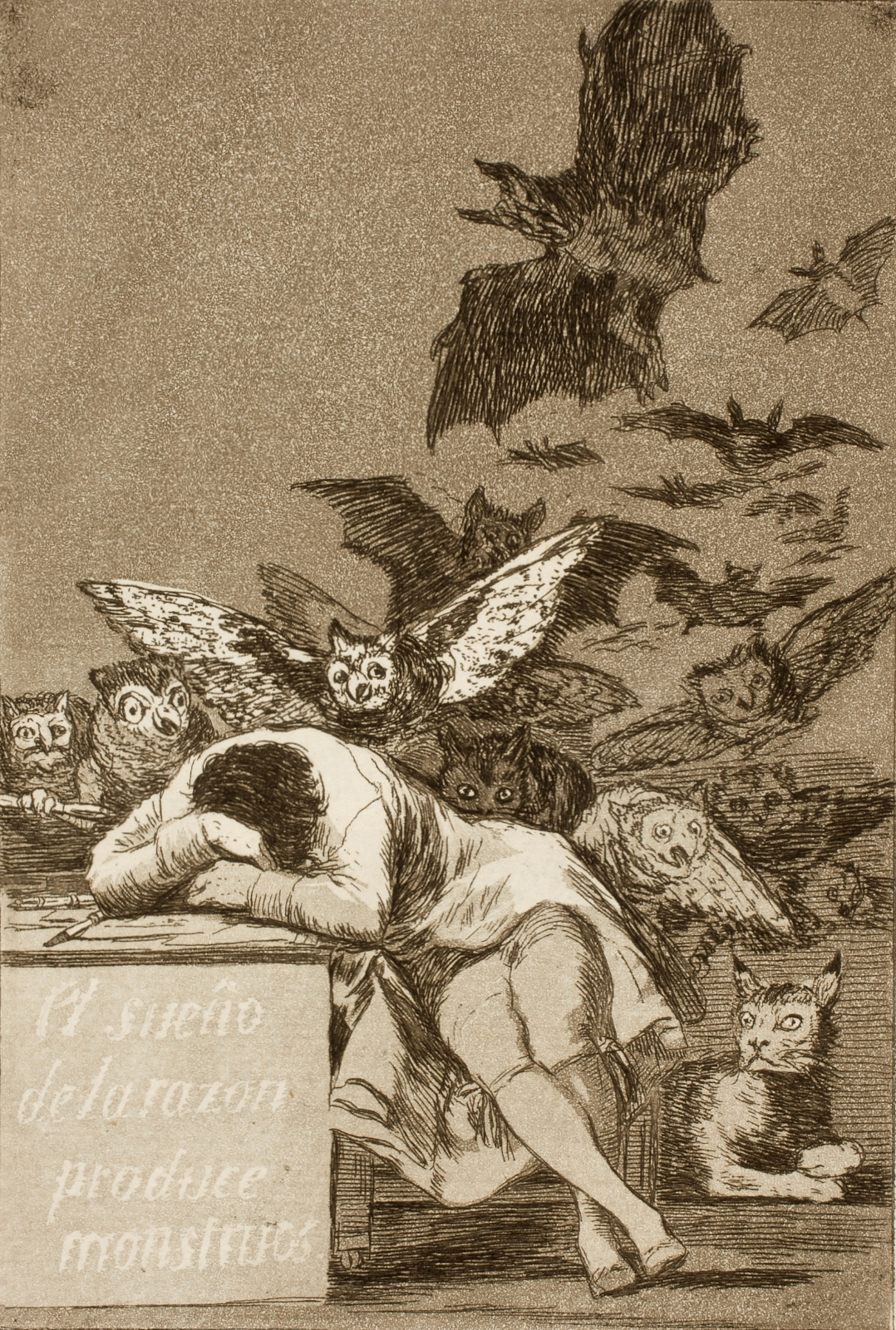
During my explorations of Francisco De Goya’s life and some his art I came across some of his paintings and they were pretty gruesome. Goya was a famous Romanticist painter but he was also a respected court painter. Goya was very respected by royalty because of his astonishing paintings of royalty and their family. Goya loved to do what he did and he was somewhat of a happy man. A series of unfortunate events turned changed Goya into a dark artist. First Goya contracted a serious fever which left him deaf. Somehow that changed Gayo into a more withdrawn person. He let out some his anger towards Spanish society in a set of 80 aquatint prints he called the Caprichos. But why did Goya, all of a sudden, start hating the society in which he lived in? The aquatint prints are pretty clever and creative. There was one that I thought was pretty interesting and it was titled The Sleep of Reason produces Monsters. In this print a man is sleeping with his head on top of a book. Behind him creatures of the night surround him and appear to be waiting for him. I am not sure what this painting represents or how it was meant to criticize Spanish society. But I do know he was a Romanticist painter and that imagination was more important to him than reason. Perhaps this print means that reason produces some unfortunate events. Can anyone else interpret the meaning of this print?

Monday, February 18, 2008

Egg as an Adhesive

In my previous post I asked about what an emulsifier is and why egg yolk is one. I found the answer one this website: http://www.exploratorium.edu/cooking/eggs/eggscience.html. Emulsions are mixtures of liquids that do not mix well together. Egg yolk contains many different proteins such as Lecithin that stabilize the emulsion and allow the two mixtures to disperse with one another. A common example of an emulsion is oil in water mixture. Oil does not mix well with water and so an emulsifier is need for the oil to be dispersed in the water. With egg yolk you create a binder for these two liquids. In paint, egg yolk and water are mixed to create an adhesive. Paint stick on to its painting medium because of this adhesive. Plus, paint is a binder for the pigment. This is a great website for a short simple explanation of emulsions. It turns out emulsions are part of a bigger type of mixture called colloids. All I know about them is that they are heterogeneous mixtures that compose of matter mixing with another unmixable matter. They can consist of any state of matter except a gas with gas mixture. This website also mentioned how an emulsifier stabilizes the system. But it never mentioned how it does that, so why does an emulsifier stabilize an emulsion? Why is egg yolk such a great emulsifier?

Sunday, February 17, 2008

Help with Paint Research

During my investigations of egg tempera paint I discovered many websites detailing a step by step process on creating it and a small history of egg tempera paint. That is great and all, but I am struggling to find any other information besides that. So if anyone knows any good websites for finding more different information then I would appreciate it. Anyways, the information I found is decent so far. For example, if you visit this website, http://www.geocities.com/CollegePark/Library/2036/tempera.html, you will find a decent amount of information detailing the different part of paint. First you have a liquid. In tempera paint the liquid is water. Then you have the binder which acts as an adhesive for the pigment, liquid, and the canvas you are painting on. For egg tempera the binder is egg yolk. Egg yolk mixed with water makes a powerful binder. Finally, the pigment gives the paint its color. In prehistoric times, humans used natural pigments such as charcoal and cadmium for color. Then it describes the different ways one could create a binder which could then be sued to create paint. Of course, there are still many unanswered questions such as, why egg yolk is such a powerful adhesive. I understand why a binder and pigment are needed for paint but why a liquid? Also, the paper mentions emulsions, but all they state is that egg yolk is an emulsifier. What is and emulsifier? To add to that is another small section on the history of prehistoric pigments.

Wednesday, February 13, 2008

Romanticism Art

I've been researching this Romanticism art and it has caught my attention. This type of art is very interesting because it is painted almost right out of the imagination of a person. Almost like something you would see in a dream. It is imaginative and dreamy. I see lots of animals, vibrant colors, trees, mountains, water, and humans. This art was a critique of the Industrial Revolution (I.R.) because the I.R. was time of machines, order, and work. Romanticism art was the oposite of that since it emphasized imagination, nature, and individualism. Below is an example of Romanticism art called, Horse Frightened by a Lion. As you can see, the picture depicts a horse runnning away from something. Theres some bushes and trees in the backround. It looks as if it just came out of someone's mind.


I also looked at some art that came before Romanticism which was NeoClassicism. This art was heavily influenced by Greek and Roman art. It depicted idols, gods, heroes, royalty, and things of that manner. It was not as colorful as Romanticism nor as imaginative but it perhaps had more meaning than it. The below painting is a famous French painting that is an example of Neoclassicism. You see royalty and Greek style architecture in the backround.

Monday, February 11, 2008

About This Blog

Welcome to my blog! I created this blog for the purpose of sharing my research and work to all. My posts will mostly relate to the new project I am currently working on. It is called the (Art)IFACTS Project and we are going to learn how modern art is a reflection of modern culture. There are many aspects to this project such as the paint making chemistry section. In this section we are going to write procedures on creating certain pigments. In the Humanities aspect we will research relevant time periods such as WWI and the Industrial Revolution and see how they tie in with art.